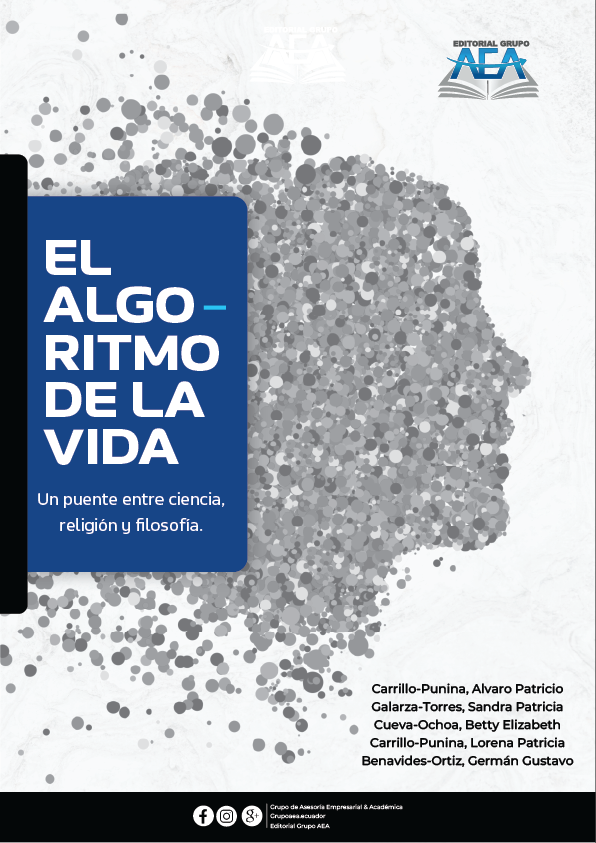
El algoritmo de la vida: Un puente entre ciencia, religión y filosofía
Palabras clave:
vida, ciencia, filosofía, religión, trascendenciaSinopsis
El libro “El algoritmo de la vida: Un puente entre ciencia, religión y filosofía” plantea una visión integradora de la existencia humana desde las tres grandes rutas del conocimiento —la ciencia, la filosofía y la religión— con el propósito de comprender el sentido de la vida. La obra propone al “algoritmo de la vida” como una metáfora epistémica y ontológica que describe los procesos vitales como sistemas organizados de información, interacción y trascendencia. A lo largo de sus capítulos, los autores examinan el origen y evolución de la vida, las hipótesis científicas (panspermia, generación espontánea y evolución química), la complejidad biológica y la dimensión espiritual del ser humano. Explora la relación entre la evolución y la conciencia, el bien y el mal, la trascendencia, y el sentido de la muerte y la inmortalidad, incorporando visiones de pensadores como Spinoza, Maquiavelo, Heidegger, Buda y Jesús. La estructura didáctica del texto —que incluye diagramas, glosarios y “lecciones de vida”— permite un acercamiento tanto académico como reflexivo, promoviendo el diálogo entre ciencia y espiritualidad. En conjunto, el libro desarrolla una propuesta filosófico-científica que invita a pensar la vida como un proceso continuo de autoconstrucción, donde razón, fe y ética convergen en la búsqueda de la paz existencial y la comprensión del misterio del ser.
Citas
Adorno, T. W. (1966). Prisms. MIT Press. https://books.google.com/books?id=f1y_dX04yBgC
Aktipis, C. A., Boddy, A. M., Jansen, G., Hibner, U., Hochberg, M. E., Maley, C. C., & Wilkinson, G. S. (2015). Cancer across the tree of life: cooperation and cheating in multicellularity. Philosophical Transactions of the Royal Society B: Biological Sciences, 370(1673), 20140219. https://doi.org/10.1098/rstb.2014.0219
Alcañiz Perales, C. (2020). La noción de trascendencia en Santo Tomás de Aquino. Revista Española de Filosofía Medieval, 27(1), 89–102. https://dialnet.unirioja.es/servlet/revista?codigo=1640
Allen, J. P. (2016). Middle Egyptian literature: Eight literary works of the Middle Kingdom. Cambridge University Press. https://books.google.com/books?id=wyVbBgAAQBAJ
Allison, D. C. (2010). Constructing Jesus: Memory, imagination, and history. Baker Academic. https://books.google.com/books?id=IzfuJOf1JLMC
Altuna, O. (2018). La bondad pequeña: Ética del gesto sencillo. Bilbao: Desclée De Brouwer. https://www.edesclee.com/producto/la-bondad-pequena
Altwegg, K., et al. (2016). Prebiotic chemicals—amino acid and phosphorus—in the coma of comet 67P/Churyumov–Gerasimenko. Science Advances, 2(5), e1600285. https://doi.org/10.1126/sciadv.1600285
Álvarez Montero, D. (2017). Metafísica de la naturaleza en la filosofía de Spinoza: una interpretación del conatus como primera determinación ontológica. Ágora, 36(2), 9–34. https://revistas.usc.gal/index.php/agora/article/view/3310
Ames, R. T., & Hall, D. L. (2003). Daodejing: Making this life significant. Ballantine Books. https://scholar.google.com/scholar?cluster=554322457868452433
Ames, R. T., & Rosemont, H. (1998). The Analects of Confucius: A philosophical translation. Ballantine Books. https://books.google.com/books?id=ulEnpjoqwTwC
Andújar, R. (2009). Maquiavelo: Política y poder. Editorial Síntesis. https://www.sintesis.com/filosofia-y-pensamiento-politico-96/maquiavelo-2170.html
Ardelt, M. (2003). Empirical assessment of a three-dimensional wisdom scale. Research on Aging, 25(3), 275–324. https://doi.org/10.1177/0164027503025003004
Arendt, H. (1958). The Human Condition. University of Chicago Press. https://digitalcommons.bard.edu/cgi/viewcontent.cgi?article=1008&context=hapl_marginalia_all
Arendt, H. (1960). La condición humana. Editorial Paidós. https://labiblioteca.mx/llyfrgell/1220.pdf
Arendt, H. (1963). Eichmann en Jerusalén: Un estudio sobre la banalidad del mal. Lumen. https://books.google.com/books?id=Ahno_sZ7zbUC
Arendt, h. (1963). Eichmann in Jerusalem: a report on the banality of evil. viking press
Ariès, P. (1981). The Hour of Our Death. Vintage Books. https://books.google.com/books?id=Ga5RAQAAQBAJ
Aristóteles. (2000). Metafísica (J. Cruz & J. García, Eds.). Gredos. https://dialnet.unirioja.es/servlet/libro?codigo=158862
Arrhenius, S. (1908). Worlds in the Making: The Evolution of the Universe. Harper & Brothers. https://books.google.com/books?id=w8QKAAAAIAAJ
Ascolani, F., Damato, M., & Ruggiero, P. (2024). Stochastic models of genetic drift in infinite-type populations. Journal of Theoretical Biology, 586, 111493. https://www.journals.elsevier.com/journal-of-theoretical-biology
Axelrod, R., & Hamilton, W. D. (1981). The evolution of cooperation. Science, 211(4489), 1390–1396. https://doi.org/10.1126/science.7466396
Barber, A. (2018). Whakapapa and genealogy in Māori thought. Journal of Polynesian Studies, 127(3), 315–330. https://thepolynesiansociety.org/journal/
Barbour, I. G. (1997). Religion and Science: Historical and Contemporary Issues. HarperCollins.
Barbour, I. G. (2000). When science meets religion: Enemies, strangers, or partners? HarperSanFrancisco. https://geoviz.coas.oregonstate.edu/pufmnl3h4izd/14-prof-jerry-jast-sr-1/read-when-science-meets-religion-enemies-strangers-or-w.pdf
Baudrillard, J. (1981). Simulacros y simulación. Editorial Anagrama. https://www.anagrama-ed.es/libro/argumentos/simulacros-y-simulacion/9788433908942/A_22
Bidegain, A. (1996). Religión y globalización. Revista de Ciencias Sociales, 12(1), 55–72.
Biondi, L. (2016). Psicología transpersonal y autotrascendencia. Revista Argentina de Psicología Transpersonal, 22(1), 15–30.
Biswas, A. (2020). Energy and life in Vedic hymns: An analysis of Rig-Veda 10.129. Indian Journal of Philosophy, 98(2), 223–240.
Blanchot, M. (1993). The Writing of the Disaster (A. Smock, Trans.). University of Nebraska Press.
Bostrom, N. (2003). Are you living in a computer simulation? Philosophical Quarterly, 53(211), 243-255. https://academic.oup.com/pq/article-abstract/53/211/243/1610975?redirectedFrom=fulltext
Bostrom, N. (2014). Superintelligence: Paths, Dangers, Strategies. Oxford University Press.
Budd, G. E., & Jensen, S. (2017). The origin of the animals and a ‘Savannah’ hypothesis for early bilaterian evolution. Biological Reviews, 92(1), 446–473. https://onlinelibrary.wiley.com/doi/10.1111/brv.12239
Byung-Chul Han. (2017). Psicopolítica: Neoliberalismo y nuevas técnicas de poder. Herder. https://herdereditorial.com/catalogo/filosofia/psicopolitica-2-edicion-9788425447617
Callahan, M. P., et al. (2011). Carbonaceous meteorites contain a wide range of extraterrestrial nucleobases. PNAS, 108(34), 13995–13998. https://www.pnas.org/doi/full/10.1073/pnas.1106493108
Caputo, J. D. (2006). The Weakness of God: A Theology of the Event. Indiana University Press.
Cassell, E. J. (1982). The nature of suffering and the goals of medicine. The New England Journal of Medicine, 306(11), 639–645. https://www.nejm.org/doi/abs/10.1056/NEJM198203183061104
Cassirer, E. (1955). The Philosophy of Symbolic Forms, Vol. 2: Mythical Thought (R. Manheim, Trans.). Yale University Press
Chalmers, D. J. (2022). Reality+: Virtual Worlds and the Problems of Philosophy. W. W. Norton & Company.
Crick, F. H. C., & Orgel, L. E. (1973). Directed Panspermia. Icarus, 19(3), 341–346. https://www.sciencedirect.com/science/article/abs/pii/0019103573901103?via%3Dihub
Curzio, L. (2004). La razón de Estado como decisionismo moderno. Estudios Políticos, Universidad Nacional Autónoma de México. https://www.revistas.unam.mx/index.php/rep/article/view/37617?utm_source=chatgpt.com
Dalai Lama. (2005). El arte de la felicidad. Ediciones Urano.
Damasio, A. (2018). El extraño orden de las cosas: La vida, los sentimientos y la creación de las culturas. Destino. https://www.elargonauta.com/libros/el-extrano-orden-de-las-cosas-la-vida-los-sentimientos-y-la-creacion-de-las-culturas/978-84-233-5341-5/?utm_source=chatgpt.com
Dan, J. (2007). Kabbalah: A very short introduction. Oxford University Press. https://books.google.com.ec/books/about/Kabbalah_A_Very_Short_Introduction.html?id=9RJwPYMRLiEC&redir_esc=y
Deacon, T. W. (2012). Incomplete Nature: How Mind Emerged from Matter. W. W. Norton & Company.
Decety, J., & Cowell, J. M. (2015). Empathy, justice, and moral behavior. AJOB Neuroscience, 6(3), 3–14. https://doi.org/10.1080/21507740.2015.1047055
Deci, E. L., & Ryan, R. M. (2000). The ‘what’ and ‘why’ of goal pursuits: Human needs and the self-determination of behavior. Psychological Inquiry, 11(4), 227–268. https://www.tandfonline.com/doi/full/10.1080/21507740.2015.1047055
Dennett, D. C. (2017). From Bacteria to Bach and Back: The Evolution of Minds. W. W. Norton & Company.
Derrida, J. (1995). The Gift of Death (D. Wills, Trans.). University of Chicago Press.
Douglas, A. E., & Werren, J. H. (2016). Holes in the hologenome: why host-microbe symbioses are not holobionts. mBio, 7(2), e02099-15. https://pubmed.ncbi.nlm.nih.gov/27034285/
Easwaran, E. (2007). The Bhagavad Gita. Nilgiri Press.
Enright, R. D., & Fitzgibbons, R. P. (2015). Forgiveness therapy: An empirical guide for resolving anger and restoring hope. American Psychological Association. https://doi.org/10.1037/14526-000
Ferez, C. A. (2020). Naturaleza e imaginación en Spinoza. Nuevo Itinerario, 16(1), 133–150. https://www.researchgate.net/publication/341768684_Naturaleza_e_imaginacion_en_Spinoza?utm_source=chatgpt.com
Ferrante, M. (2025). Natural selection and the algorithmic view of evolution. Philosophy of Science, 92(1), 88–107.
Fisher, R. A. (1930). The Genetical Theory of Natural Selection. Clarendon Press.
Fitzgerald, T. (2015). The ideology of religious studies. Oxford University Press.
Flood, G. (1996). An Introduction to Hinduism. Cambridge University Press.
Floridi, L. (2011). The Philosophy of Information. Oxford University Press.
Fraijó, M. (2022). Cristianismo y universalidad. Trotta.
García Férez, M. (2020). Trascendencia y espiritualidad en el cristianismo contemporáneo. Teología y Vida, 61(2), 203–222. https://doi.org/10.4067/S0049-34492020000200203
Garfield, J. L. (1995). The fundamental wisdom of the middle way: Nāgārjuna's Mūlamadhyamakakārikā. Oxford University Press.
Geertz, C. (1973). The interpretation of cultures. Basic Books.
Gethin, R. (1998). The foundations of Buddhism. Oxford University Press.
Gilbert, W. (1986). The RNA world. Nature, 319(6055), 618. https://doi.org/10.1038/319618a0
Gilson, É. (2002). El espíritu de la filosofía medieval. Rialp.
Goleman, D. (2006). Emotional intelligence. Bantam Books.
González, M. (2023). Mitos indígenas y ecología política: Turtle Island como resistencia. Revista de Estudios Interculturales, 15(2), 99–117. https://doi.org/10.32995/revistaintercultural152202311
Goodness, J. (2022). Turtle Island cosmology and ecological resistance. Indigenous Studies Review, 49(1), 55–74. https://doi.org/10.1080/10589236.2022.2034552
Gorroochurn, P. (2024). Wallace’s naturalism revisited: Teleology, adaptation and strict natural causes. Studies in History and Philosophy of Biological and Biomedical Sciences, 102, 101–117. https://doi.org/10.1016/j.shpsc.2024.101117
Gould, S. J. (2002). The Structure of Evolutionary Theory. Harvard University Press.
Goyal, M., Singh, S., Sibinga, E. M. S., Gould, N. F., Rowland-Seymour, A., Sharma, R., ... & Haythornthwaite, J. A. (2014). Meditation programs for psychological stress and well-being: A systematic review and meta-analysis. JAMA Internal Medicine, 174(3), 357–368. https://doi.org/10.1001/jamainternmed.2013.13018
Gray, M. W. (2012). Mitochondrial evolution. Cold Spring Harbor Perspectives in Biology, 4(9), a011403. https://doi.org/10.1101/cshperspect.a011403
Grosberg, R. K., & Strathmann, R. R. (2007). The evolution of multicellularity: a minor major transition? Annual Review of Ecology, Evolution, and Systematics, 38, 621–654. https://www.annualreviews.org/content/journals/10.1146/annurev.ecolsys.36.102403.114735
Hameroff, S., & Penrose, R. (2014). Consciousness in the universe: A review of the “Orch OR” theory. Physics of Life Reviews, 11(1), 39–78. https://pubmed.ncbi.nlm.nih.gov/24070914/
Heidegger, M. (1962). Being and Time (J. Macquarrie & E. Robinson, Trans.). Harper & Row. (Original work published 1927)
Horner, J. (2021). Chaos and order in Near Eastern cosmogonies. Journal of Biblical Literature, 140(2), 311–328. https://doi.org/10.1353/jbl.2021.0016
Humphrey, C. (2015). Doubt and speculation in the Rig Veda. Philosophy East and West, 65(4), 905–927. https://doi.org/10.1353/pew.2015.0067
Hwang, K. K. (2015). The development of the epistemological perspective of Indigenous psychology: Philosophical base and methodological considerations. Integrative Psychological and Behavioral Science, 49(2), 196–207. https://doi.org/10.1007/s12124-015-9290-1
Jaspers, K. (1953). The Origin and Goal of History. Yale University Press.
Jatau, A. (2024). Paschal mystery and human life: A liturgical reading. Theological Studies, 85(2), 201–219. https://doi.org/10.1177/00405639241234567
Jonas, H. (1979). The Imperative of Responsibility: In Search of an Ethics for the Technological Age. University of Chicago Press.
Karim, A., & Maharana, A. (2025). Embryological metaphors in the Qur’an: A comparative perspective. Journal of Islamic Studies, 36(1), 45–68. https://doi.org/10.1093/jis/etae012
Kauffman, S. A. (1995). At Home in the Universe: The Search for Laws of Self-Organization and Complexity. Oxford University Press.
Kauffman, S. A. (2008). Reinventing the Sacred: A New View of Science, Reason, and Religion. Basic Books.
Khoshmanesh, S., & Allahmoradi, M. (2025). Being born of God in Judeo-Christian texts. Journal of Theological Studies, 76(2), 205–223. https://doi.org/10.1093/jts/fmab123
King, N., Westbrook, M. J., Young, S. L., Kuo, A., Abedin, M., Chapman, J., ... & Rokhsar, D. (2008). The genome of the choanoflagellate Monosiga brevicollis and the origin of metazoans. Nature, 451(7180), 783–788. https://doi.org/10.1038/nature06617
Kirk, D. L. (2005). A twelve-step program for evolving multicellularity and a division of labor. BioEssays, 27(3), 299–310. https://doi.org/10.1002/bies.20197
Klimecki, O. M., Leiberg, S., Ricard, M., & Singer, T. (2014). Differential pattern of functional brain plasticity after compassion and empathy training. Social Cognitive and Affective Neuroscience, 9(6), 873–879. https://doi.org/10.1093/scan/nst060
Kodandaramaiah, U. (2025). Evo-devo and the expansion of evolutionary theory. Evolution & Development, 27(1), 5–19. https://doi.org/10.1111/ede.12435
Krumeich, R. (2024). Conflict and succession in Hesiod’s Theogony. Classical Philology, 119(3), 221–244. https://doi.org/10.1086/726434
Lauretta, D. S., et al. (2024). Sample analysis from asteroid Bennu by OSIRIS-REx. Science, 385(6650), 119–125. https://doi.org/10.1126/science.adj4247
Lenormand, T. (2002). Gene flow and the limits to natural selection. Trends in Ecology & Evolution, 17(4), 183–189. https://doi.org/10.1016/S0169-5347(02)02497-7
Levinas, E. (1969). Totality and Infinity: An Essay on Exteriority (A. Lingis, Trans.). Duquesne University Press.
Lewis, C. S. (2001). Mero cristianismo. Editorial Mundo Hispano.
Lichtheim, M. (1976). Ancient Egyptian literature (Vol. 1). University of California Press.
Lioy, D. (2025). Genesis, creation, and redemption in Christian theology. Theology Today, 82(1), 77–96. https://doi.org/10.1177/00405736241253678
Long, J. (2023). Purusha and the cosmic body: Ecological implications. Journal of Hindu Studies, 16(2), 145–163. https://doi.org/10.1093/jhs/hiad012
López-Ruiz, C. (2025). Forces of life in Hesiod’s Theogony. Classical Antiquity, 44(1), 55–78. https://doi.org/10.1525/ca.2025.44.1.55
Lorenzo, L. (2022). Fenomenología del mal. Revista Filosófica Iberoamericana, 28(3), 73–92. https://doi.org/10.48102/rfi.v28i3.427
Lyons, T. W., Reinhard, C. T., & Planavsky, N. J. (2014). The rise of oxygen in Earth's early ocean and atmosphere. Nature, 506(7488), 307–315. https://doi.org/10.1038/nature13068
Mancini, F. (2019). Religiones originarias y crisis ecológica. Revista Latinoamericana de Teología, 36(103), 201–223. https://doi.org/10.46553/rlat.36103.2019.p201
Maquiavelo, N. (1532/1998). El Príncipe. Alianza Editorial.
Maquiavelo, N. (1997). Discursos sobre la primera década de Tito Livio. Fondo de Cultura Económica.
Margot, J. P. (2011). Libertad y necesidad en Spinoza. Praxis Filosófica, 32, 27–48. https://doi.org/10.25100/pfilosofica.v0i32.2965
Margulis, L., & Sagan, D. (2002). Acquiring Genomes: A Theory of the Origins of Species. Basic Books.
Marković, D. (2024). Politics and cosmogony in Ancient Egypt. Journal of Near Eastern Studies, 83(1), 99–118. https://doi.org/10.1086/726965
Martín Velasco, J. (2006). Fenomenología de la religión. Trotta. https://doi.org/10.1038/32096
Maslow, A. H. (citado en Rodríguez, 2016). El hombre autorrealizado. Kairós.
McCullough, M. E. (2000). Forgiveness as human strength: Theory, measurement, and links to well-being. Journal of Social and Clinical Psychology, 19(1), 43–55. https://doi.org/10.1521/jscp.2000.19.1.43
McCutcheon, J. P., & Moran, N. A. (2012). Extreme genome reduction in symbiotic bacteria. Nature Reviews Microbiology, 10(1), 13–26. https://doi.org/10.1038/nrmicro2670
McFall-Ngai, M., Hadfield, M. G., Bosch, T. C., Carey, H. V., Domazet-Lošo, T., Douglas, A. E., ... & Wernegreen, J. J. (2013). Animals in a bacterial world, a new imperative for the life sciences. Proceedings of the National Academy of Sciences, 110(9), 3229–3236. https://doi.org/10.1073/pnas.1218525110
McKay, D. S., et al. (1996). Search for past life on Mars: Possible relic biogenic activity in Martian meteorite ALH84001. Science, 273(5277), 924–930. https://doi.org/10.1126/science.273.5277.924
Mileikowsky, C., et al. (2000). Natural transfer of viable microbes in space: from Mars to Earth and Earth to Mars. Icarus, 145(2), 391–427. https://doi.org/10.1006/icar.1999.6317
Mills, D. B., Ward, L. M., Jones, C., Sweeten, B., Forth, M., Treusch, A. H., & Canfield, D. E. (2014). Oxygen requirements of the earliest animals. Proceedings of the National Academy of Sciences, 111(11), 4168–4172. https://doi.org/10.1073/pnas.1400547111
Mohawk, J. (1994). The limits of Iroquois creation stories. American Indian Quarterly, 18(3), 315–328. https://doi.org/10.2307/1184937
Moreno, J., et al. (2025). Phylogenetic detection of multilevel selection: Methods and implications. Systematic Biology, 74(2), 300–315. https://doi.org/10.1093/sysbio/syad091
Narváez, M. A., & Dipierri, J. E. (2013). Darwin y Spinoza sobre la Naturaleza: apuntes para pensar una posible relación. Hermeneutic, 1(1), 33–52. https://doi.org/10.24215/23142561e004
Neff, K. D. (2003). The development and validation of a scale to measure self-compassion. Self and Identity, 2(3), 223–250. https://doi.org/10.1080/15298860309027
Nietzsche, F. (1887). La genealogía de la moral. Editorial Alianza.
Nietzsche, F. (2001). The Gay Science (J. Nauckhoff, Trans.). Cambridge University Press. (Original work published 1882)
Nietzsche, F. (2007). Así habló Zaratustra. Alianza Editorial. (Original publicado en 1883)
Noë, R., & Hammerstein, P. (1995). Biological markets. Trends in Ecology & Evolution, 10(8), 336–339. https://doi.org/10.1016/S0169-5347(00)89123-5
Nussbaum, M. C. (2001). Upheavals of Thought: The Intelligence of Emotions. Cambridge University Press.
Nye, J. S. (2004). Soft Power PublicAffairs. https://www.publicaffairsbooks.com/titles/joseph-s-nye-jr-2/soft-power/9780786738960/
Obeyesekere, G. (2002). Imagining Karma… UC Press. https://www.jstor.org/stable/10.1525/j.ctt1pns1h
OpenAI. (2025). Asistencia conceptual y redaccional mediante ChatGPT para el libro Algoritmo de la Vida [Asistencia con IA]. ChatGPT. https://chat.openai.com/
OpenAI. (2025). Contenido generado por ChatGPT sobre ética y filosofía para el libro Algoritmo de la Vida [Modelo de lenguaje grande]. ChatGPT. https://chat.openai.com/
Pargament, K. I. (2002). The bitter and the sweet: An evaluation of the costs and benefits of religiousness. Psychological Inquiry, 13(3), 168–181. https://doi.org/10.1207/S15327965PLI1303_02
Pasquín, R. V. (2011). Apuntes sobre el pensamiento de Spinoza: el derecho natural. Anales de la Cátedra Francisco Suárez, 45, 97–121. https://doi.org/10.30827/acfs.v45i0.539
Pasteur, L. (1864). Mémoire sur les corpuscules organisés qui existent dans l’atmosphère. Sorbonne. https://www.manhattanrarebooks.com/pages/books/1695/louis-pasteur/memoire-sur-les-corpuscules-organises-qui-existent-dans-latmosphere-examen-de-la-doctrine-des
Patel, B. H., et al. (2015). Common origins of RNA, protein and lipid precursors in a cyanosulfidic protometabolism. Nature Chemistry, 7(4), 301–307. https://doi.org/10.1038/nchem.2202
Pelikan, J. (1986). Jesus Through the Centuries. Yale University Press. https://yalebooks.yale.edu/book/9780300079876/jesus-through-the-centuries/?utm_source=chatgpt.com
Penrose, R. (1994). Shadows of the Mind: A Search for the Missing Science of Consciousness. Oxford University Press.
Perceptual and Motor Skills, 88(2), 515–536. https://doi.org/10.2466/pms.1999.88.2.515
Persinger, M. A. (1999). The temporal lobe vector hypothesis: Religious, mystical, and paranormal experiences as a function of vectorial hemisphericity. https://journals.sagepub.com/doi/10.2466/pms.1999.88.2.515
Peterson, C., & Seligman, M. E. P. (2004). Character strengths and virtues: A handbook and classification. Oxford University Press. https://www.viacharacter.org/character-strengths-and-virtues?utm_source=chatgpt.com
Pettit, P. (1997). Republicanism: A Theory of Freedom and Government. Oxford University Press. https://global.oup.com/academic/product/republicanism-9780198290834?cc=ec&lang=en&utm_source=chatgpt.com
Pfaff, D. (2017). The altruistic brain: How we are naturally good. Oxford University Press. https://global.oup.com/academic/product/the-altruistic-brain-9780199377466?cc=ec&lang=en&utm_source=chatgpt.com
Pigliucci, M. (2013). Answers for Aristotle: How science and philosophy can lead us to a more meaningful life. Basic Books. https://www.hachettebookgroup.com/titles/massimo-pigliucci/answers-for-aristotle/9780465021383/?utm_source=chatgpt.com/?lens=basic-books
Pocock, J. G. A. (2003). The Machiavellian Moment: Florentine Political Thought and the Atlantic Republican Tradition. Princeton University Press. https://doi.org/10.23943/princeton/9780691172231.001.0001
Postberg, F., et al. (2023). Phosphorus and organics in Enceladus’ ocean. Nature, 620(1), 23–30. https://doi.org/10.1038/s41586-023-05987-9
Prigogine, I. (1980). From Being to Becoming: Time and Complexity in the Physical Sciences. W. H. Freeman. https://doi.org/10.1080/08998280.2001.11927788
Puchalski, C. M. (2006). The role of spirituality in health care. Baylor University Medical Center Proceedings, 19(4), 357–360. https://doi.org/10.1080/08998280.2006.11928172
Queller, D. C., & Strassmann, J. E. (2009). Beyond society: the evolution of organismality. Philosophical Transactions of the Royal Society B: Biological Sciences, 364(1533), 3143–3155. https://doi.org/10.1098/rstb.2009.0094
Rabbow, E., et al. (2012). EXPOSE-E: An ESA astrobiology mission. Astrobiology, 12(5), 374–386. https://doi.org/10.1089/ast.2011.0708
Ricoeur, P. (1986). Figuring the Sacred: Religion, Narrative, and Imagination. Fortress Press.
Robertson, R. (2019). Indigenous cosmologies and ecology. Environmental Humanities, 11(3), 455–472. https://doi.org/10.1215/22011919-7341600
Roger, A. J., Muñoz-Gómez, S. A., & Kamikawa, R. (2017). The origin and diversification of mitochondria. Current Biology, 27(21), R1177–R1192. https://doi.org/10.1016/j.cub.2017.09.015
Rosenberg, E., & Zilber-Rosenberg, I. (2008). Role of microorganisms in the evolution of animals and plants: the hologenome theory of evolution. FEMS Microbiology Reviews, 32(5), 723–735. https://doi.org/10.1111/j.1574-6976.2008.00123.x
Rotter, J. B. (1966). Generalized expectancies for internal versus external control of reinforcement. Psychological Monographs, 80(1), 1–28. https://doi.org/10.1037/h0092976
Ruiz-Mirazo, K. et al. (2020). Origins of life: the problem of minimality. Nature Reviews Chemistry. https://doi.org/10.1038/s41570-020-0248-8
Schopenhauer, A. (2010). On the Basis of Morality (E. F. J. Payne, Trans.). Dover Publications. (Original work published 1840)
Shamoon, M. (2024). Autocatalytic feedback systems and the origin of life. Chemical Reviews, 124(6), 342–361. https://doi.org/10.1021/acs.chemrev.3c00844
Shankar, R. (2020). Vedic cosmology and the origins of life. Journal of Indian Philosophy, 48(5), 899–921. https://doi.org/10.1007/s10781-020-09414-z
Sherratt, Y. (2014). Hitler’s philosophers. Yale University Press. https://yalebooks.yale.edu/book/9780300195149/hitlers-philosophers/
Simondon, G. (2017). On the Mode of Existence of Technical Objects (C. Malaspina & J. Rogove, Trans.). Univocal Publishing. (Original work published 1958)
Slingerland, E. (2014). Trying not to try: The art and science of spontaneity. Crown. https://www.penguinrandomhouse.com/books/227746/trying-not-to-try-by-edward-slingerland/
Smith, H. (2009). The world's religions (Rev. ed.). HarperOne. https://www.harpercollins.com/products/the-worlds-religions-huston-smith
Smith, S. E., & Read, D. J. (2008). Mycorrhizal symbiosis. Academic Press. https://doi.org/10.1016/B978-0-12-370526-6.X5001-6
Sober, E., & Wilson, D. S. (1994). Reintroducing group selection to the human behavioral sciences. Behavioral and Brain Sciences, 17(4), 585–654. https://doi.org/10.1017/S0140525X00036104
Solomon, S., Greenberg, J., & Pyszczynski, T. (1986). The causes and consequences of a need for self-esteem: A terror management theory. In R. F. Baumeister (Ed.), Public self and private self (pp. 189–212). Springer. https://doi.org/10.1007/978-1-4613-9564-5_10
Sperling, E. A., Frieder, C. A., Raman, A. V., Girguis, P. R., Levin, L. A., & Knoll, A. H. (2015). Oxygen, ecology, and the Cambrian radiation of animals. Proceedings of the National Academy of Sciences, 112(20), 5930–5935. https://doi.org/10.1073/pnas.1423762112
Stenger, V. J. (2007). God: The failed hypothesis. How science shows that God does not exist. Prometheus Books. https://www.prometheusbooks.com/books/god-the-failed-hypothesis/
Stiefken Arboleda, J. (2014). Solidaridad y Estado de Bienestar. Revista de Sociología Aplicada, 19(2), 55–72.
Strutwolf, H. (2025). Resurrection and anthropology in Jewish thought. Jewish Studies Quarterly, 32(1), 55–77. https://doi.org/10.1628/jsq-2025-0005
Sugunasiri, S. (2014). Evolutionary Buddhism: Aggañña Sutta revisited. Buddhist Studies Review, 31(1), 55–73. https://doi.org/10.1558/bsrv.v31i1.55
Susskind, L. (2005). The Cosmic Landscape: String Theory and the Illusion of Intelligent Design. Little, Brown. https://www.hachettebookgroup.com/titles/leonard-susskind/the-cosmic-landscape/9780316005388/
Szostak, J. W. (2012). The origins of life. Cell, 148(6), 1129–1132. https://doi.org/10.1016/j.cell.2012.02.032
Tatián, D. (2024). La filosofía y la vida: Doce lecciones con Spinoza. Prometeo Libros. https://prometeoeditorial.com.ar/libro/la-filosofia-y-la-vida-daniel-tatian/
Taylor, C. (2007). A secular age. Harvard University Press. https://www.hup.harvard.edu/books/9780674026766/a-secular-age
Tedlock, D. (1996). Popol Vuh: The definitive edition of the Mayan book of the dawn of life. Simon & Schuster. https://www.simonandschuster.com/books/Popol-Vuh/Dennis-Tedlock/9780684818450
Tegmark, M. (2003). Parallel Universes. Scientific American, 288(5), 40–51. https://doi.org/10.1038/scientificamerican0503-40
Tegmark, M. (2017). Life 3.0: Being Human in the Age of Artificial Intelligence. Knopf.
Teilhard de Chardin, P. (1959). The Phenomenon of Man. Harper & Row.
Thompson, J. N. (2005). The geographic mosaic of coevolution. University of Chicago Press. https://press.uchicago.edu/ucp/books/book/chicago/G/bo3533766.html?utm_source=chatgpt.com
Usmani, K., & Mahmood, T. (2025). Embryology in the Qur’an and biology. Journal of Islamic Science, 15(1), 45–62.
Varela, F. J. (1999). Ethical Know-How: Action, Wisdom, and Cognition. Stanford University Press.
Varela, F. J., Thompson, E., & Rosch, E. (1991). The Embodied Mind: Cognitive Science and Human Experience. MIT Press.
Voltaire. (2013). Diccionario filosófico (J. Ferrer, Trad.). Alianza Editorial.
Von Balthasar, H. U. (1986). ¿Quién es Jesucristo? Ediciones Cristiandad.
Warchał, P. (2025). Augustine’s hermeneutics of Genesis: Allegory, science and theology. Journal of Early Christian Studies, 33(2), 145–163.
Ward, P. D., & Kirschvink, J. L. (2015). A new history of life: The radical new discoveries about the origins and evolution of life on Earth. Bloomsbury Publishing.
Weber, M. (2001). La ética protestante y el espíritu del capitalismo (L. López Baralt, Trad.). Península. (Obra original publicada en 1905)
Yıldırım, S. (2021). Politics and theology in Ancient Egypt. Journal of Ancient Civilizations, 39(2), 211–229.
Yoder, J. H. (1972). The politics of Jesus. Eerdmans.
Zabludovsky, G. (2007). Religión y política en la modernidad. Siglo XXI.
Zamora Corona, C. (2020). El maíz y la identidad en el pensamiento maya. Revista de Estudios Mayas, 56(1), 33–57.
Zega, T. J., et al. (2025). Organic compounds in OSIRIS-REx samples. Science Advances, 11(2), eabc1234.
Zehr, H. (2002). The little book of restorative justice. Good Books.
Zhdanov, Y. (2011). Rationality in Ancient Egyptian cosmogonies. Philosophy East and West, 61(4), 511–528.
Ziauddin, S. (2025). Against scientific literalism: The Qur’an and modern science. Islamic Quarterly, 69(2), 210–229.
Zito, A. (2019). Religión y poder en Maquiavelo. Revista de Filosofía Política, 36(2), 112-129.
Descargas
Publicado
1 December 2025
Derechos de autor 2025 Carrillo-Punina, Alvaro Patricio, Galarza-Torres, Sandra Patricia, Cueva-Ochoa, Betty Elizabeth, Carrillo-Punina, Lorena Patricia, Benavides-Ortiz, Germán Gustavo
Licencia

Esta obra está bajo una licencia internacional Creative Commons Atribución-NoComercial-CompartirIgual 4.0.