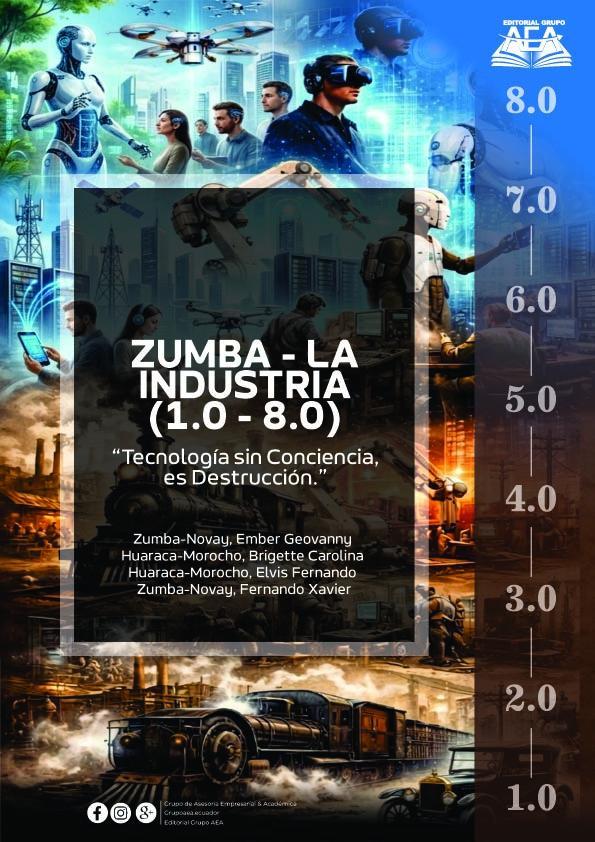
Zumba - La Industria (1.0 - 8.0) “Tecnología sin conciencia es destrucción”
Palabras clave:
Revoluciones industriales, Industria 5.0, Sostenibilidad, Ética tecnológica, Conciencia industrialSinopsis
Se ofrece un análisis crítico y prospectivo de la evolución de las revoluciones industriales desde la Industria 1.0 hasta la Industria 8.0, abordando la relación entre tecnología, ética, sociedad y conciencia humana. La obra parte del reconocimiento de una crisis global marcada por el deterioro ambiental, la desigualdad social y el uso desmedido de la tecnología, evidenciando las limitaciones de los modelos industriales tradicionales centrados únicamente en la eficiencia y el crecimiento económico. La Industria 5.0 se presenta como el retorno del ser humano al centro del sistema productivo, promoviendo la colaboración humano–máquina, el liderazgo consciente y la dignidad laboral. La Industria 6.0 amplía esta visión al integrar justicia tecnológica, responsabilidad social y el rol del Estado y la academia en la regulación ética de la innovación, orientando la tecnología hacia la reducción de brechas sociales y el bienestar colectivo. La Industria 7.0 redefine el propósito de la industria al orientarla hacia la regeneración del planeta, la economía circular real y la protección de los sistemas naturales, reconociendo el agua, el aire y el suelo como bienes fundamentales para la vida. En esta etapa, la ingeniería asume una responsabilidad activa en la restauración ambiental y en la prevención del daño ecológico. La Industria 8.0 representa el nivel más alto de madurez civilizatoria planteado en la obra, donde la ciencia reconoce sus límites, la tecnología se subordina a la ética y la conciencia humana, y el conocimiento se ejerce como servicio al bien común. La inteligencia artificial y los sistemas avanzados adquieren legitimidad únicamente cuando respetan la dignidad humana y la responsabilidad intergeneracional. El libro destaca el papel estratégico de la educación en ingeniería mediante el proyecto EENTITLE y la certificación iPEER, como pilares para formar profesionales conscientes, éticos y comprometidos con la transformación industrial. La obra concluye con una visión de legado, donde la integración de ciencia, valores y fe se plantea como base para un desarrollo industrial humano, justo y sostenible, al servicio de las presentes y futuras generaciones.
Citas
Adithya, M. A., Geetha, R., Sundar, S., Varghese, M. A., & Velmurugan, P. R. (2025). Bibliometric analysis of the evolution of smart factories and sustainable manufacturing in Industry 4.0. Discover Sustainability, 6(1), 1179-. https://doi.org/10.1007/S43621-025-02034-7/FIGURES/3
Akman, A. Z., & Erdirencelebi, M. (2024). A Human-Centered Digital Transformation: A Bibliometric Analysis of Society 5.0 and Industry 5.0. Istanbul Management Journal, 0(96), 1–16. https://doi.org/10.26650/IMJ.2024.96.1361480
Almusaed, A., Yitmen, I., & Almssad, A. (2023). Reviewing and Integrating AEC Practices into Industry 6.0: Strategies for Smart and Sustainable Future-Built Environments. Sustainability 2023, Vol. 15, Page 13464, 15(18), 13464. https://doi.org/10.3390/SU151813464
Alves, J., Lima, T. M., & Gaspar, P. D. (2023). Is Industry 5.0 a Human-Centred Approach? A Systematic Review. Processes 2023, Vol. 11, Page 193, 11(1), 193. https://doi.org/10.3390/PR11010193
Alviz-Meza, A., Vásquez-Coronado, M. H., Delgado-Caramutti, J. G., & Blanco-Victorio, D. J. (2022). Bibliometric analysis of fourth industrial revolution applied to heritage studies based on web of science and scopus databases from 2016 to 2021. Heritage Science 2022 10:1, 10(1), 189-. https://doi.org/10.1186/s40494-022-00821-3
Amador Matute, A. M. (2024). Logística 5.0: Tendencias y Desafíos para la Industria. https://uvadoc.uva.es/handle/10324/70213
Antonaci, F. G., Olivetti, E. C., Marcolin, F., Castiblanco Jimenez, I. A., Eynard, B., Vezzetti, E., & Moos, S. (2024). Workplace Well-Being in Industry 5.0: A Worker-Centered Systematic Review. Sensors 2024, Vol. 24, Page 5473, 24(17), 5473. https://doi.org/10.3390/S24175473
Ashwin, V. (2025). Industry 6.0: Vision, technical landscape, and opportunities. Alexandria Engineering Journal, 130, 139–174. https://doi.org/10.1016/J.AEJ.2025.08.040
Bussolan, A., Avram, O., Pignata, A., Urgese, G., Baraldo, S., & Valente, A. (2025). Personalized Mental State Evaluation in Human-Robot Interaction using Federated Learning. https://arxiv.org/abs/2506.20212v1
Campus. (2023). ¿Cómo están ayudando la inteligencia artificial y el aprendizaje automático en la Industria 4.0? | campusMVP.es. https://www.campusmvp.es/recursos/post/Como-estan-ayudando-la-Inteligencia-Artificial-y-el-aprendizaje-automatico-en-la-revolucion-industrial-4-0.aspx?srsltid=AfmBOop5q_QqGElibBswog6e_4nR7QBjYALh1sBEBjLbq0DVeExnX_MB
Carrillo, L. (2024). Impacto de la industria 4.0 en las PYMES del sector textil en Colombia, sus desafíos y oportunidades. http://repository.unad.edu.co/handle/10596/73249
Castellonos, J. (2023). NDUSTRIA 5.0: UN ENFOQUE CENTRADO EN EL SER HUMANO. https://invassat.gva.es/documents/161660384/370674470/AT-230102+Industria+5.0+Un+enfoque+centrado+en+el+ser+humano.pdf/d72f0ce1-b98a-f345-6589-67c85aee1921?t=1753872439354
Crăciun, A. F., Umar, M., Qin, M., Nicolescu, A. C., & Lobonț, O. R. (2025). Digital Metamorphosis: Harnessing Transformation in the Public Sector for Sustainable Governance and Resilience. Springer Proceedings in Business and Economics, 1–29. https://doi.org/10.1007/978-3-031-91778-3_1
Damaševičius, R., & Misra, S. (2024). The rise of industry 6.0: Seizing the opportunities of the post-COVID-19 era for sustainable manufacturing. Emerging Technologies and Security in Cloud Computing, 478–494. https://doi.org/10.4018/979-8-3693-2081-5.CH020
Das, S., & Pan, T. (2022). A strategic outline of Industry 6.0: Exploring the Future. SSRN Electronic Journal. https://doi.org/10.2139/SSRN.4104696
Diotto, P. (2024). Gestión comunitaria del riesgo Diálogos necesarios para un campo en construcción. https://sedici.unlp.edu.ar/bitstream/handle/10915/175664/Documento_completo.pdf?sequence=1#page=44
Doboviček, S., Purkovi´c, P., Fabi´c, M. F., Jurkovic, Z., Hozdi´c, E. H., & Makovec, I. (2023). Evolution of the Human Role in Manufacturing Systems: On the Route from Digitalization and Cybernation to Cognitization. Applied System Innovation 2023, Vol. 6, Page 49, 6(2), 49. https://doi.org/10.3390/ASI6020049
Driess, D., Xia, F., Sajjadi, M. S. M., Lynch, C., Chowdhery, A., Ichter, B., Wahid, A., Tompson, J., Vuong, Q., Yu, T., Huang, W., Chebotar, Y., Sermanet, P., Duckworth, D., Levine, S., Vanhoucke, V., Hausman, K., Toussaint, M., Greff, K., … Florence, P. (2023). PaLM-E: An Embodied Multimodal Language Model. Proceedings of Machine Learning Research, 202, 8469–8488.
Eriksson, K. M., Olsson, A. K., & Carlsson, L. (2024). Beyond lean production practices and Industry 4.0 technologies toward the human-centric Industry 5.0. Technological Sustainability, 3(3), 286–308. https://doi.org/10.1108/TECHS-11-2023-0049
Espina-Romero, L., Guerrero-Alcedo, J., Goñi Avila, N., Noroño Sánchez, J. G., Gutiérrez Hurtado, H., & Quiñones Li, A. (2023). Industry 5.0: Tracking Scientific Activity on the Most Influential Industries, Associated Topics, and Future Research Agenda. Sustainability 2023, Vol. 15, Page 5554, 15(6), 5554. https://doi.org/10.3390/SU15065554
Fernández-Miguel, A., García-Muiña, F. E., Ortíz-Marcos, S., Jiménez-Calzado, M., Fernández del Hoyo, A. P., & Settembre-Blundo, D. (2025). AI-Driven Transformations in Manufacturing: Bridging Industry 4.0, 5.0, and 6.0 in Sustainable Value Chains. Future Internet 2025, Vol. 17, Page 430, 17(9), 430. https://doi.org/10.3390/FI17090430
Fernández-Miguel, A., Ortíz-Marcos, S., Jiménez-Calzado, M., Fernández del Hoyo, A. P., García-Muiña, F. E., & Settembre-Blundo, D. (2025). Toward the Theoretical Foundations of Industry 6.0: A Framework for AI-Driven Decentralized Manufacturing Control. Future Internet 2025, Vol. 17, Page 455, 17(10), 455. https://doi.org/10.3390/FI17100455
Gdoce. (2024). la electrónica, la informática y los primeros sistemas de control programable. industria 3.0 plc - Google Search. https://www.google.com/search?q=la+electr%C3%B3nica%2C+la+inform%C3%
González-González, I., & Pilar Martínez-Ruiz Juan Jose Blázquez-Resino, M. (2025). EL IMPACTO DE LAS ÚLTIMAS TECNOLOGÍAS EN LA TRANSFORMACIÓN DE LA INDUSTRIA.
Goyal, R. K. (2025). Industry 6.0: A Paradigm Shift Towards Environmentally Centric Robotics. Applied Energy & Artificial Intelligence, 1(2), 40–48. https://doi.org/10.55938/AEAI.V1I2.216
Handjiski, B., Martinovic, R., & Crittenden, C. (2025). 2025 How Nations Can Redefine Economic Progress The Industry 5.0 Index.
Hermida Bravo, K. R., Luna Luna, M. A., Vizcaíno Zúñiga, P. I., Hermida Bravo, K. R., Luna Luna, M. A., & Vizcaíno Zúñiga, P. I. (2025). Impacto de la tecnología en el desarrollo y bienestar emocional. Revista InveCom, 5(3). https://doi.org/10.5281/ZENODO.14218923
Hu, J. L., Li, Y., & Chew, J. C. (2025). Industry 5.0 and Human-Centered Energy System: A Comprehensive Review with Socio-Economic Viewpoints. Energies 2025, Vol. 18, Page 2345, 18(9), 2345. https://doi.org/10.3390/EN18092345
Icapval. (2025). industria 5.0 - Google Search. https://www.google.com/search?q=industria+5.0&sca_esv=a7ea5b6f397deb12&udm=2&biw=1536&bih=738&sxsrf=AE3TifM_AxPQaiAM7935Hx7nPUHfh9gAuw
Inspenet. (2002). La Industria 2.0, desarrollada entre finales del siglo XIX y comienzos del siglo XX, introduce la electricidad, la producción en masa y la línea de ensamblaje. La ingeniería industrial adquiere un papel central mediante la división del trabajo, la optimi…. https://www.google.com/search?sca_esv=a7ea5b6f397deb12&sxsrf=
Kaigom, E. G. (2025). Deep Generative and Discriminative Digital Twin endowed with Variational Autoencoder for Unsupervised Predictive Thermal Condition Monitoring of Physical Robots in Industry 6.0 and Society 6.0. https://arxiv.org/abs/2509.12740v1
Kaswan, M. Singh., Rathi, Rajeev., & Garza-Reyes, J. Arturo. (2025). Industry 5.0 : concepts and strategies for digital transformation. CRC Press. https://www.routledge.com/Industry-50-Concepts-and-Strategies-for-Digital-Transformation/Kaswan-Rathi-Garza-Reyes/p/book/9781032878218
Kumar, U., Kumar, R., Singh, M., Singh, M., Singh, H., Singh, R., & Chabra, R. (2025). A Critical Review on History of Industrial Revolutions. AIP Conference Proceedings, 3185(1). https://doi.org/10.1063/5.0240534/3346427
Llamas, M. (2024). ASPECTOS ECONÓMICOS DE LA CUARTA REVOLUCIÓN INDUSTRIAL (ECONOMIC ASPECTS OF THE FOURTH INDUSTRIAL REVOLUTION).
Lykov, A., Cabrera, M. A., Konenkov, M., Serpiva, V., Gbagbe, K. F., Alabbas, A., Fedoseev, A., Moreno, L., Khan, M. H., Guo, Z., & Tsetserukou, D. (2024a). Industry 6.0: New Generation of Industry driven by Generative AI and Swarm of Heterogeneous Robots. https://arxiv.org/abs/2409.10106v1
Madsen, D. Ø., Berg, T., & Di Nardo, M. (2023). Bibliometric Trends in Industry 5.0 Research: An Updated Overview. Applied System Innovation 2023, Vol. 6, Page 63, 6(4), 63. https://doi.org/10.3390/ASI6040063
Madsen, D. Ø., Slåtten, K., & Berg, T. (2025). From Industry 4.0 to Industry 6.0: Tracing the Evolution of Industrial Paradigms Through the Lens of Management Fashion Theory. Systems 2025, Vol. 13, Page 387, 13(5), 387. https://doi.org/10.3390/SYSTEMS13050387
Montil, J. (2026). Innovacionysostentabilidad260108.
Mubarik, M. S. (2025). Overcoming barriers to digital transformation: Challenges of implementing innovative digital technologies in supply chains. Technological Innovations and Industry 5.0: A Supply Chain Perspective, 19–36. https://doi.org/10.1016/B978-0-443-33813-7.00002-6
Muhammad, H. (2026). INDUSTRY 5.0 : the human-centric future of industry muhammad hammad....et al. SPRINGER NATURE. https://link.springer.com/book/9783032126214
Pereira, R., Ilieva, G., Yankova, T., Staribratov, P., Ruseva, G., & Iliev, Y. (2025). Industrial Digitalization: Systematic Literature Review and Bibliometric Analysis. Information 2025, Vol. 16, Page 1080, 16(12), 1080. https://doi.org/10.3390/INFO16121080
Pérez-Domínguez, L. A. (2024). Las principales tecnologías de la era de la industria 5.0. Revista Ingenio, 21(1), 60–70. https://doi.org/10.22463/2011642x.4352
Rejeb, A., Rejeb, K., Zrelli, I., & Süle, E. (2025). Industry 5.0 as seen through its academic literature: an investigation using co-word analysis. Discover Sustainability 2025 6:1, 6(1), 307-. https://doi.org/10.1007/S43621-025-01166-0
Risk. (2025). Industry 7.0 - Universal Risk. https://universalrisk.org/uncategorized/industry-7-0-2/?utm_source=chatgpt.com
Sayed, E. (2025). Decision Intelligence in the Age of Industrial Transformation: A Survey from Industry 4.0 to Industry 7.0. Sustainable Machine Intelligence Journal, 12(1), 17. https://doi.org/10.61356/SMIJ.2025.12565
Sheikh, R. A., Ahmed, I., Faqihi, A. Y. A., & Shehawy, Y. M. (2025). Global Perspectives on Navigating Industry 5.0 Knowledge: Achieving Resilience, Sustainability, and Human-Centric Innovation in Manufacturing. Journal of the Knowledge Economy, 16(5), 15997–16032. https://doi.org/10.1007/S13132-024-02498-4
Stradioto, L., & Frazzon, E. M. (2023). Digital transformation in Brazilian industry: bridging theory and practice. Production, 33, e20220076. https://doi.org/10.1590/0103-6513.20220076
Tellez Bedoya, C. A., & Tellez Bedoya, C. (2022). Retos de la salud mental para la cuarta revolución industrial en las empresas de Colombia. Tendencias, 23(2), 332–358. https://doi.org/10.22267/rtend.222302.211
Tipan, A. V. T., & Garzon, C. M. V. (2023). Industria 5.0, revisión del pasado y futuro de la producción y la industria. Ciencia Latina Revista Científica Multidisciplinar, 7(1), 1059–1070. https://doi.org/10.37811/CL_RCM.V7I1.4457
Valette, E., Bril El-Haouzi, H., & Demesure, G. (2023). Industry 5.0 and its technologies: A systematic literature review upon the human place into IoT- and CPS-based industrial systems. Computers and Industrial Engineering, 184. https://doi.org/10.1016/j.cie.2023.109426
Vanguardia. (2000). maquina de vapor - Google Search. https://www.google.com/search?q=maquina+de+vapor&sca_esv=a7ea5b6f397deb12&udm=2&biw=1536&bih=738&sxsrf=AE3TifPmjxA0vg5kvtCsWEEdIECXiFK64g%3A1766950360877&ei=2IVRad2dNcWGwbkPtOmVmAQ&ved=
Verma, A., Prasad, V. K., Kumari, A., Bhattacharya, P., Srivastava, G., Fang, K., Wang, W., & Gadekallu, T. R. (2025). Industry 6.0: Vision, technical landscape, and opportunities. Alexandria Engineering Journal, 130, 139–174. https://doi.org/10.1016/j.aej.2025.08.040
Wang, B. (2018). The Future of Manufacturing: A New Perspective. Engineering, 4(5), 722–728. https://doi.org/10.1016/J.ENG.2018.07.020
Zhang, C., Wang, Z., Zhou, G., Chang, F., Ma, D., Jing, Y., Cheng, W., Ding, K., & Zhao, D. (2023). Towards new-generation human-centric smart manufacturing in Industry 5.0: A systematic review. Advanced Engineering Informatics, 57, 102121. https://doi.org/10.1016/J.AEI.2023.102121
Zumba, E. (2020). INDUSTRIA 4.0 PROPUESTAS PARA EL ECUADOR EMBER ZUMBA - YouTube. https://www.youtube.com/watch?v=43TRi5S7wfk
Zumba, E., Novay, F. X. Z., & Robles, C. J. P. (2025). Desafíos del 2050 su contaminación y los vehículos eléctricos. Unidad de Producción y Difusión Científica y Académica. https://doi.org/10.32645/9789942625519
Мажара, Г. А., & Кориштенська, Ю. Я. (2025). ГЕНЕЗА АДАПТИВНОСТІ ЕКОНОМІЧНОЇ ПОВЕДІНКИ ПІДПРИЄМСТВ В УМОВАХ ІНДУСТРІЙ 1.0 - 8.0. Економічний Вісник Національного Технічного Університету України «Київський Політехнічний Інститут», (33), 222–228. https://doi.org/10.20535/2307-5651.33.2025.335920
Descargas
Próximamente
21 April 2026
Derechos de autor 2026 Zumba-Novay, Ember Geovanny, Huaraca-Morocho, Brigette Carolina, Huaraca-Morocho, Elvis Fernando, Zumba-Novay, Fernando Xavier
Licencia

Esta obra está bajo una licencia internacional Creative Commons Atribución-NoComercial-CompartirIgual 4.0.